COMPLIANCE
Sharia-Compliant Lending Infrastructure: What Actually Has to Change at the Ledger Layer
Sharia-compliant lending infrastructure requires the double-entry ledger to record distinct asset acquisition, ownership, markup disclosure, and deferred sale or lease events for Murabaha, Ijara, and Mudaraba facilities rather than accruing interest on a loan principal. Trazmo executes these structure-specific journal sequences in Vertex and exports timestamped transaction trails for each institution's Sharia Supervisory Board review.
Most fintech companies that advertise Sharia-compliant lending products have done one thing: they have renamed interest as a fee. The underlying system still works as a conventional loan. The rate is calculated the same way. The ledger records the same journal entries. A compliance label sits on top of mechanics that have not changed at all.
This matters because regulators, Sharia auditors, and institutional risk teams look past the label. In Pakistan, the State Bank of Pakistan (SBP) has pushed the scheduled banking sector toward full Islamic banking conversion. Across Bahrain and the GCC, the Central Bank of Bahrain (CBB), SAMA, and the CBUAE enforce strict Sharia supervisory frameworks for licensed Islamic banks, windows, and financing companies. The structural requirements for a compliant SME product start at the accounting layer, not the product naming layer.
This guide is for credit product heads, CROs, and infrastructure teams at regulated banks and NBFCs building or evaluating SME financing products that must pass Sharia Supervisory Board (SSB) audit in practice.
What Sharia compliance requires at the product structure level
The foundational distinction between a conventional loan and a Sharia-compliant financing facility is not interest versus fee. It is what the financier is actually selling, leasing, or funding.
In a Murabaha structure (the primary instrument for SME working capital and trade financing), the institution purchases an asset or inventory on behalf of the SME and sells it to the customer at a disclosed markup on deferred payment terms. The institution earns a fixed profit margin, not interest. That structure is valid only if the financier takes constructive or actual ownership of the asset before selling it onward. A Murabaha that skips the asset acquisition step and records a cash disbursement as an asset sale is a conventional loan with a renamed field.
In an Ijara structure (used for equipment, vehicle, and asset financing), the institution owns the asset and leases it to the SME for a defined rental period, with a separate undertaking for ownership transfer at maturity. Lease payments are rental income tied to asset usufruct, requiring the ledger to track leased asset ownership separately from receivables.
In a Mudaraba structure, the institution provides capital while the operating partner manages the commercial activity under a pre-agreed profit-sharing ratio, with financial loss borne by the capital provider absent negligence or breach.
Each structure dictates a different transaction sequence, chart of accounts, ownership record, and repayment waterfall.
The ledger requirements are specific
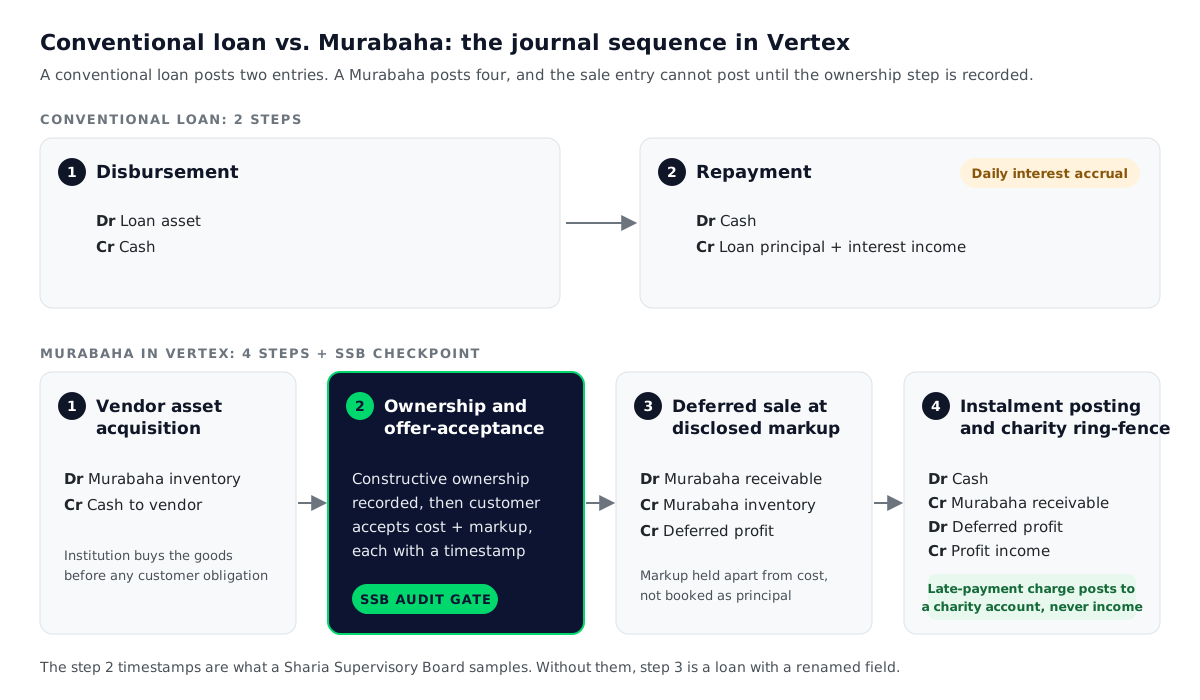
A conventional loan on a double-entry ledger is straightforward. On disbursement: debit loan asset, credit cash. On repayment: debit cash, credit loan principal and interest income.
A Murabaha facility on a real-time double-entry ledger like Vertex requires a distinct state and journal sequence:
- Vendor or asset acquisition: Record the institution's purchase of the underlying goods or commodity before the customer financing obligation activates.
- Ownership and offer-acceptance checkpoint: Log the constructive ownership step and timestamped customer acceptance at the disclosed cost plus profit markup.
- Deferred sale recognition: Recognise the Murabaha receivable and deferred profit margin separately from conventional principal.
- Instalment and rebate handling: Post repayments against the deferred sale obligation and recognise profit across the schedule without daily compounding interest accrual. Late-payment charity allocations (where mandated by the lender's SSB) post to a ring-fenced charity ledger account, never to lender income.
The same discipline applies to each structure. The table below sets out what the ledger has to record, how income is recognised, and what an SSB reviewer expects to find in the file.
| Structure | Typical SME use case | Required ledger sequence in Vertex | Income recognition | SSB audit trail artifact |
|---|---|---|---|---|
| Murabaha | Working capital, inventory, invoice or supply-chain purchase | 1. Asset acquisition entry. 2. Ownership timestamp. 3. Deferred markup sale entry. 4. Instalment and charity ring-fence. | Fixed disclosed profit markup over tenure (no compounding interest) | Timestamped purchase invoice, ownership transfer log, and offer-acceptance sequence |
| Ijara | Equipment, machinery, commercial vehicles | 1. Leased asset balance-sheet entry. 2. Rental schedule activation. 3. Separate maturity transfer entry. | Rental income recognised per lease period against leased asset | Asset title and ownership record, lease contract log, and separate transfer undertaking |
| Mudaraba | Trade and merchant working-capital pools | 1. Capital pool contribution entry. 2. Revenue and profit distribution split. 3. Capital recovery posting. | Pre-agreed profit share ratio from realised net profit | Pool accounting statement, profit-calculation log, and loss-attribution verification |
For a platform built around conventional loans, supporting these structures is not a UI label change. It requires balanced double-entry transaction types that separate asset acquisition from customer obligation, prevent interest-on-late-payment from touching lender revenue, and preserve an immutable sequence of events.
Sharia Supervisory Board requirements and audit trails
During an SSB audit in Pakistan or the GCC, scholars do not merely review the product brochure. They sample executed files and verify that the ledger and document timestamps follow the approved sequence.
If a Murabaha file shows a single disbursement timestamp with no preceding asset purchase and offer-acceptance event, the transaction fails SSB review regardless of what the contract header says.
Combining Vertex with Sentinel solves this at the infrastructure layer:
- Policy-gated sequence enforcement: An application cannot advance to customer sale or disbursement until the prerequisite asset or agency step is recorded.
- Immutable audit pack: Every credit rule evaluation, document extraction, contract step, and journal entry carries an immutable timestamp and operator ID, exportable in the format the institution's Sharia board and regulator expect.
What this means for multi-lender and bank orchestration
Whether an institution runs a single-lender book (such as a scheduled bank or Islamic window in Pakistan) or routes SME volume across multiple funding lines in Bahrain and the GCC, the infrastructure layer must treat Sharia structure as an execution rule rather than a tag:
- Eligibility and routing: Match each SME application and facility type to the right credit policy and Sharia structure before commitment.
- Book and facility separation: Keep Sharia-compliant funding facilities and conventional lines segregated at the Vault treasury and Vertex ledger layers.
- Lender control: The regulated institution keeps its scholar board approval, its credit decision, and its balance sheet. Trazmo runs the operational rail underneath.
Conclusion
Sharia-compliant SME lending infrastructure is built at the ledger, transaction sequence, and audit-trail layer. When the accounting core enforces asset acquisition before markup sale, ring-fences late-payment charity flows, and exports a clean transaction log for SSB sampling, a bank or NBFC can scale SME volume without accumulating Sharia audit liability.
To see how Trazmo configures Murabaha, Ijara, and Mudaraba workflows alongside your core banking system, explore Vertex or book a working session.